Magnesium nitrate is used when a crop needs soluble magnesium and immediately available nitrate nitrogen, but the correct form, concentration, and application method depend on the nutrient plan. By the end, you will be able to read the assay, calculate the actual nutrient supplied, choose an application route, diagnose whether magnesium nitrate fits, and distinguish fertilizer uses from industrial ones.
Key takeaways
- Use magnesium nitrate hexahydrate, not anhydrous magnesium nitrate, for practical fertilizer handling.
- Confirm magnesium deficiency with soil or tissue testing before applying magnesium nitrate.
- Choose magnesium nitrate when crops need soluble magnesium and nitrate nitrogen together.
- Verify assay, water content, impurities, packaging, and safety documents before industrial purchase.
Which magnesium nitrate form supplies nutrients in fertilizer?
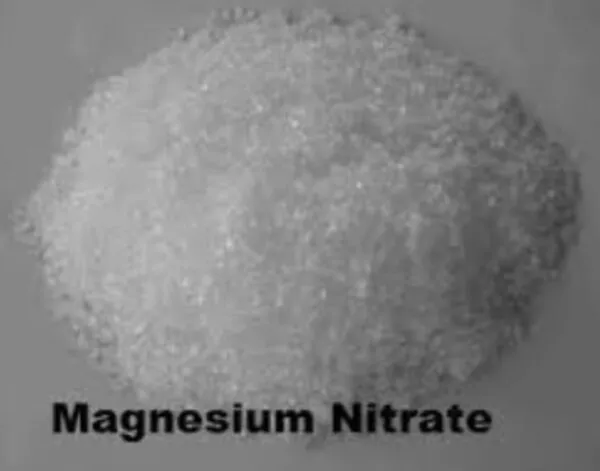
Commercial fertilizer is usually magnesium nitrate hexahydrate, Mg(NO₃)₂·6H₂O, CAS 13446-18-9, not anhydrous magnesium nitrate. The hexahydrate has a molecular weight of about 256.41 g/mol; anhydrous Mg(NO₃)₂ is about 148.31 g/mol and rapidly absorbs water, making it rarely practical for field handling.
| Form | Nutrient and handling meaning | Practical use |
|---|---|---|
| Magnesium nitrate hexahydrate | Solid fertilizer form; water-soluble nitrate-N and magnesium | Standard dry product for fertigation and soil programs |
| Anhydrous magnesium nitrate | More concentrated by mass, but strongly moisture-absorbing | Rarely selected for routine field application |
| Commercial solution | Nutrient strength depends on its stated mass or volume analysis | Liquid injection when storage and metering suit the operation |
Fertilizer-grade material commonly contains 10.5% nitrogen to 11% nitrogen and 15–16% water-soluble MgO equivalent. A label might show 11% nitrogen fertilizer analysis and 16% MgO equivalent. This nitrogen is nitrate-N, so plants can absorb it without microbial conversion.
MgO is not elemental magnesium. Multiply the MgO percentage by 0.603: 16% MgO supplies about 9.65% elemental magnesium. A 100-kilogram load therefore provides 11 kg N and 16 kg MgO.
Calculate the application rate by dividing the required nutrient by the assay. To supply 5 kg N per hectare with an 11% product, use 5 ÷ 0.11 = 45.5 kg product, which also supplies about 7.3 kg MgO. Compare labels only after checking whether they report Mg, MgO, or both.
How does magnesium nitrate work in crops and irrigation systems?
Magnesium nitrate combines two immediately available nutrients: nitrate-N, or nitrate nitrogen, supports rapid vegetative growth, while soluble magnesium enters the plant and supports chlorophyll formation and photosynthesis.
1. Use it where the crop needs both nutrients. Suitable targets include greenhouse tomatoes, peppers, cucumbers, leafy vegetables, hydroponic crops, ornamentals, fruit trees, and field crops with confirmed magnesium demand. This makes it useful in greenhouse vegetables fertilizer use when rapid, controlled feeding matters.
2. For fertigation, dissolve the product in a clean stock solution. Inject it after the irrigation system has filled and during the irrigation period, then stop before the final flush. Calculate the injection rate from the product assay and irrigation volume, not from a generic spoonful-per-tank rule.
3. Keep concentrated magnesium nitrate separate from concentrated phosphate. Combine them only after a jar test produces a clear mixture; high local phosphate concentration or high pH can form poorly soluble magnesium phosphate. Flush drip lines with clean water after injection.
4. Treat foliar spraying as a separate, narrower application. Specify the crop, growth stage, product concentration, water quality, humidity, and temperature before choosing a rate. Avoid hot, drying conditions and low-humidity spraying because concentrated salts can scorch leaves.
5. Apply it to soil when magnesium must reach the root zone. Soil treatment is less targeted than fertigation and still adds nitrate, so use it only when both the magnesium and nitrogen supply fit the crop plan.
How do you confirm magnesium deficiency before applying it?
Start with the leaf pattern: older-leaf interveinal chlorosis points toward magnesium deficiency. Magnesium moves from older leaves to new growth, so the tissue between veins turns yellow while the veins remain green.
Confirm the magnesium deficiency diagnosis with soil testing and laboratory plant tissue testing; these results help separate a true shortage from restricted roots, poor irrigation, or nutrient lockout.
| Pattern | More likely cause | What distinguishes it |
|---|---|---|
| Older leaves; yellow tissue between green veins | Magnesium deficiency | Sharply interveinal chlorosis |
| Older leaves; fairly uniform yellowing | Nitrogen deficiency | No strong green-vein pattern |
| Young leaves; yellow tissue between veins | Iron deficiency | Iron is poorly mobile |
| Newer growth; general yellowing | Sulfur deficiency | Symptoms begin in young tissue |
| Older leaves; yellow edges, scorching, or necrosis | Potassium deficiency | Damage starts along margins |
Apply magnesium nitrate when the crop needs magnesium and immediately available nitrate nitrogen together. Choose another source when soil or tissue magnesium is adequate, late-season nitrate loading is undesirable, or the nutrient plan needs sulfur instead of nitrogen. Magnesium sulfate supplies magnesium plus sulfur without nitrogen; magnesium nitrate does not preserve that nutrient balance.
Before increasing the dose, recheck:
- Irrigation-water alkalinity
- Root-zone pH
- Salinity
- Competing potassium or calcium levels
Do not repeat an application merely because deficiency symptoms appeared if tissue results already show adequate magnesium.
How does magnesium nitrate compare with other fertilizer sources?
Magnesium nitrate is the fast, fully soluble choice when you need magnesium and nitrate nitrogen in the same clear fertigation or hydroponic solution.
| Option | Adds | Best fit | Main limitation |
|---|---|---|---|
| Magnesium nitrate | Magnesium and nitrate-N | Rapid feeding through irrigation or hydroponics | Adds nitrogen even when only magnesium is needed |
| Magnesium sulfate | Magnesium and sulfur | Crops needing sulfur without extra nitrogen | Does not supply nitrate |
| Magnesium chloride fertilizer | Magnesium and chloride | Chloride-tolerant crops and selected soil uses | Chloride can increase salinity or injure sensitive crops |
| Magnesium oxide fertilizer | Concentrated magnesium | Slower soil correction | Dissolves too slowly for rapid hydroponic feeding unless specially processed |
| Calcium nitrate | Calcium and nitrate-N | Crops needing calcium | A calcium nitrate comparison shows it cannot replace magnesium without changing the calcium-to-magnesium balance |
| Potassium nitrate | Potassium and nitrate-N | Crops needing potassium | Supplies no magnesium |
| Compound NPK | Several nutrients | Broad, simplified fertilization | Gives less control over separate magnesium and nitrogen rates |
The magnesium sulfate comparison is straightforward: choose it when sulfur is needed and nitrogen is not. Compare cost per kilogram of elemental magnesium and nitrogen, then add freight, dissolution, injection, and any second sulfur or calcium product.
Solid magnesium nitrate is hygroscopic and can cake. Seal it in moisture-resistant packaging and store it in a dry, covered area away from fuels, reducing agents, organic contamination, and combustible materials because it is an oxidizing nitrate salt.
Which industrial processes use magnesium nitrate, and what should buyers verify?
The end use determines the specification: fertilizer-grade magnesium nitrate is not automatically suitable for industrial processing. Its water affinity supports nitric acid concentration, where the magnesium-nitrate phase absorbs water and then requires recovery or recycling.
| Process | Role | What controls performance |
|---|---|---|
| Nitric-acid manufacture | Dehydrating agent | Water content, assay, phase recovery, and recycle design |
| Pyrotechnic formulations | Pyrotechnic oxidizer or oxygen donor | Particle size, moisture, purity, and compatibility |
| Textile resin finishing | Textile resin finishing catalyst or catalyst component | Bath pH, concentration, drying temperature, and curing schedule |
| Precipitation, impregnation, or thermal decomposition | Magnesium oxide precursor or source of other magnesium materials | Impurity limits, precursor distribution, decomposition conditions, and alkali contamination |
Textile processors must validate the bath rather than treat magnesium nitrate as a universal auxiliary. Incorrect concentration, pH, drying, or curing can reduce fabric strength, alter shade and handle, or worsen formaldehyde performance.
Before buying, request:
- Exact form and assay
- Water content and impurity limits
- Particle-size data where the process requires it
- Safety data sheet, certificate of analysis, and batch number
- Packaging specification and transport classification
Shiv Chemicals can help match the specification to nitric-acid concentration, a textile bath, a magnesium oxide precursor process, or another defined end use. Confirm that use before accepting a substitute grade, especially for energetic formulations.
Related product
 | OTHERS refers to inorganic compounds. All are white solids. The anhydrous material is hygroscopic, quickly forming the hexa hydrate upon standing in air. View product → |
Frequently asked questions
Which form of magnesium nitrate is used in fertilizers?
Commercial fertilizer uses magnesium nitrate hexahydrate, Mg(NO₃)₂·6H₂O, CAS 13446-18-9. Anhydrous magnesium nitrate absorbs water rapidly and is difficult to handle.
How does magnesium nitrate work in crops and irrigation systems?
It dissolves readily, supplying soluble magnesium for chlorophyll formation and nitrate nitrogen for plant growth. In fertigation, confirm compatibility and prevent concentrated stock solutions from mixing with incompatible materials.
How can you confirm magnesium deficiency before applying magnesium nitrate?
Use soil testing and plant tissue analysis, then compare results with crop-specific sufficiency ranges. Check for interveinal chlorosis on older leaves, but do not rely on symptoms alone.
How does magnesium nitrate compare with other magnesium fertilizers?
Magnesium nitrate provides both soluble magnesium and nitrate nitrogen. Kieserite and dolomitic lime supply magnesium through different solubility and pH effects, while magnesium sulfate adds sulfur instead of nitrate.
Which industrial processes use magnesium nitrate, and what should buyers verify?
Industrial uses include oxidizing formulations, specialty chemical production, heat-treatment applications, and process chemistry. Buyers should verify concentration, assay, water content, impurities, batch traceability, packaging, SDS, and transport classification.