Phosphoric acid does more than lower pH: it supplies phosphate, dissolves selected mineral deposits, prepares metal surfaces, and acts as a building block for phosphate chemicals. By the end, you will be able to match each use with the right grade, dosing method, monitoring point, and equipment material while avoiding phosphate discharge and handling failures.
Key takeaways
- Treat phosphoric acid as nonoxidizing; it cannot replace nitric acid for oxidation.
- Add acid to water during dilution, using cooling and compatible equipment.
- Specify concentration, grade, impurities, packaging, and documents before procurement.
- Match dosing to water chemistry while monitoring pH, phosphate, and corrosion risk.
How phosphoric acid is used in industrial processing
Phosphoric acid serves as an acidifier, mineral dissolver, and phosphate source in industrial processing. It is treated as a nonoxidizing acid, so it will not replace nitric acid or another oxidizing chemical when oxidation is the intended reaction.
| Operation | What it does | What controls the result |
|---|---|---|
| Metal-surface treatment | Removes light oxides, mill scale, and surface contamination from steel or zinc before painting, plating, or bonding. | Acid concentration, temperature, contact time, rinsing, and dissolved metal buildup |
| Rust removal | Dissolves iron oxides and can convert remaining rust into adherent iron phosphate. | Rust thickness, agitation, immersion time, and post-treatment rinsing |
| Phosphate conversion coatings | Reacts with the metal surface to form phosphate conversion coatings that improve paint adhesion and corrosion resistance. | Free acid, total acid, accelerator chemistry, temperature, surface condition, and iron or zinc concentration |
| Catalyst preparation | Supplies phosphate and adjusts acidity while forming phosphate-based catalyst precursors or supports. | Target phosphate ratio, mixing, drying, and calcination conditions |
| Process-stream pH adjustment | Lowers pH and adds orthophosphate to a process stream. | Metered dose, alkalinity, mixing, and phosphorus discharge limits |
Phosphate coating is not simple acid pickling: excess free acid can strip the surface without producing a uniform coating. Commercial 75% and 85% solutions also differ in viscosity, freezing behavior, dilution heat, and phosphate delivered per litre. Treat phosphoric acid as a process reactant, not merely a pH-adjustment reagent.
Where phosphoric acid fits in water treatment
In water treatment, phosphoric acid provides pH adjustment and alkalinity control by consuming bicarbonate and carbonate. It lowers pH while converting part of the water’s buffering capacity into dissolved phosphate species. Near neutral water, its second dissociation, with a pKa of about 7.20, makes small doses shift pH and phosphate speciation quickly.
Scale inhibition and corrosion control depend on the treated water, not the acid name alone:
- Calcium and dissolved inorganic carbon influence mineral deposition.
- pH, temperature, and flow affect protective-film formation.
- Existing scale, oxidants, phosphate form, and residual concentration change performance.
- Orthophosphate supports lead- and copper-phosphate films; polyphosphate mainly sequesters metals and can hydrolyze.
Prevent unmanaged phosphate discharge with a mass balance from dosing point to outfall. Set residual target, measure orthophosphate in recirculating water and effluent, then compare phosphorus load with the permit and biological-treatment capacity. If limits are tight, reduce the dose, reuse the stream, or choose non-phosphate corrosion control; excess acid will not fix bad chemistry.
Phosphate chemical manufacturing and process quality
The neutralization ratio decides which phosphate forms and how the plant handles it. In chemical manufacturing, phosphoric acid reacts with a measured base, metal oxide, hydroxide, or carbonate to produce phosphate salts; pH, temperature, concentration, and residence time then control crystallization, slurry viscosity, and unreacted material.
1. Add ammonia to phosphoric acid for ammonium phosphates. A lower ammonia-to-acid ratio produces monoammonium phosphate (MAP); more ammonia produces diammonium phosphate (DAP). This ratio is central to MAP and DAP production because excess ammonia raises emissions and changes granulation behavior.
2. Neutralize with sodium, potassium, or calcium compounds to make salts for buffering, food and industrial formulations, water conditioning, and animal nutrition. Control pH during reaction to prevent unwanted precipitates and oversized crystals.
3. Blend phosphate solutions with detergent builders and sequestrants. Sodium phosphates bind hardness ions, but formulation limits and wastewater phosphate controls determine whether they remain suitable.
4. React phosphoric acid with selected nitrogen-containing or metal-based compounds to produce flame retardants and specialty phosphate chemicals. Purity, thermal stability, particle size, and residual acidity become product specifications.
Raw-acid impurities can decide whether the batch passes. Iron, aluminum, magnesium, silica, fluoride, and organic matter alter filtration, scaling, viscosity, crystal growth, and available P₂O₅ in fertilizers. Request impurity limits, P₂O₅ assay, density, suspended solids, and free acidity rather than buying on concentration alone.
Wet-process acid costs less but carries more rock-derived impurities than thermal acid.
Dosing, dilution, storage, and equipment compatibility
Dilute 75% or 85% phosphoric acid by adding acid slowly to water under continuous mixing; never pour water into concentrated acid. This safe dilution procedure controls heat generation, local boiling, splashing, and aerosol formation. Use temperature measurement and a controlled feed rate, and stop dilution if the vessel approaches its specified temperature limit.
- Confirm the acid concentration, density, temperature, and batch number before transfer.
- Use a metering pump for acid dosing, with a check valve, isolation valve, and flow indication.
- Interlock the pump with mixer operation and low-level protection in the receiving tank.
- Verify the final concentration with density or laboratory analysis, not pump time alone.
- Flush lines only with a planned, compatible method; trapped acid and water can create heat and pressure.
Equipment choice depends on concentration, temperature, impurities, residence time, and pressure. Use a supplier compatibility chart rather than assuming that a material suitable for dilute acid suits 85% acid.
| Equipment | Common candidate | Check before approval |
|---|---|---|
| Storage tank | HDPE, PP, FRP, or lined steel | Temperature, grade, lining, vent, and crystallisation risk |
| Pump and valves | Fluoropolymer-lined or suitable alloy equipment | Seal, diaphragm, pressure, and dry-run limits |
| Hose and pipework | Compatible fluoropolymer, rubber, plastic, or lined systems | Flexing, permeation, joints, and temperature |
| Concrete bund | Acid-resistant coating or lining | Concrete compatibility is not automatic |
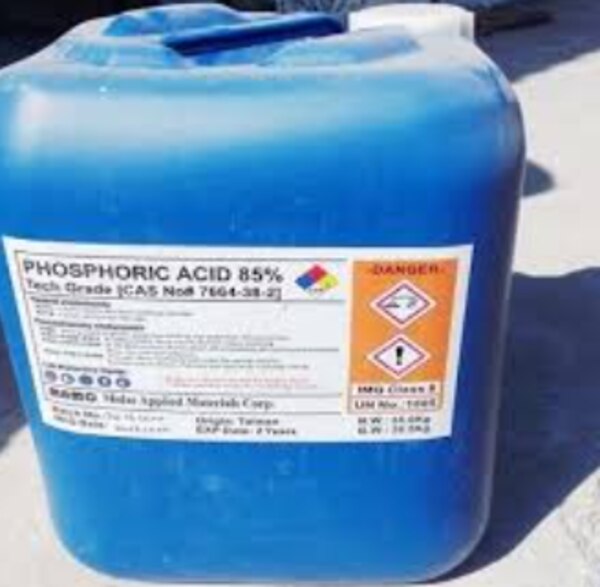
Store tanks under cover with secondary containment, protected vents, level indication, and leak detection. Maintain the grade above its crystallisation threshold, especially for 85% acid, or blocked outlets and damaged pumps can result. Monitor tank temperature, concentration, flow, level, and dosing-point pH.
Choosing a phosphoric acid grade and procurement specification
Grade follows contamination risk, not acid strength alone. Technical grade suits fertilizer, metal treatment, and general process work when its impurity profile is compatible. Food grade meets food-additive controls, commonly including FCC or local food-law requirements.
Reagent grade is manufactured and tested for tighter analytical impurity limits, so it costs more than a process needs when trace analysis is not the purpose.
| Grade | Main control | Appropriate use |
|---|---|---|
| Technical grade | Process performance and declared impurities | Fertilizer, surface treatment, industrial pH adjustment |
| Food grade | Food-additive purity and permitted contaminants | Food, beverage, and pharmaceutical processes requiring that status |
| Reagent grade | Lot-specific analytical limits and test methods | Laboratory analysis and high-sensitivity chemical testing |
Wet-process acid carries impurities from phosphate rock; thermal acid is cleaner but costs more because it uses elemental phosphorus and greater energy. In fertilizer plants, compare more than concentration because iron, aluminum, magnesium, silica, and fluorine can change viscosity, filtration, crystal growth, scaling, and available P₂O₅.
Put these figures on the purchase specification and compare them by batch:
- H₃PO₄ concentration and P₂O₅ assay
- iron, aluminum, magnesium, silica, and fluoride
- chloride and sulfate
- heavy metals, including lead, arsenic, and mercury where relevant
- insoluble matter, color, density, and test method
Ask Shiv Chemicals for a batch-specific certificate of analysis, concentration, packing details, and traceability before approving a technical-grade delivery. Reject a certificate that gives only “80–90%” without impurity limits when those impurities affect your reaction, product, discharge, or equipment.
Related product
 | TEXTILE CHEMICALS Product Description Being a well-distinguished company in the market, we are into offering Phosphoric Acid. View product → |
Frequently asked questions
How is phosphoric acid used in industrial processing?
It acts as an acidifier, mineral dissolver, and phosphate source in process formulations and cleaning operations.
What role does phosphoric acid play in water treatment?
It adjusts acidity and supplies phosphate, but dosing must account for water chemistry, phosphate limits, and corrosion control.
What should you specify when buying phosphoric acid?
State the concentration, grade, impurity limits, packaging, batch documentation, and intended process use.
How should phosphoric acid be diluted and stored?
Add acid to water slowly with cooling, use compatible equipment, and store it in a labeled, corrosion-resistant container.